
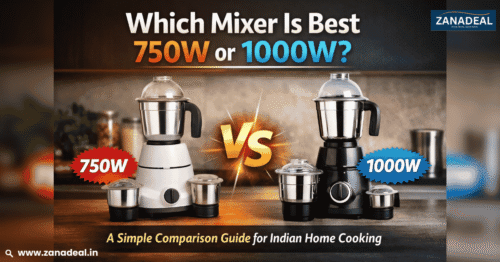
Choosing the right mixer grinder can be confusing, especially when the question is which mixer is best 750W or 1000W for everyday home use. With so many models available in the market, many buyers struggle to understand how much power they actually need. Wattage plays an important role in performance, electricity consumption, noise, and long-term durability. While higher wattage sounds more powerful, it may not always be the practical choice for every kitchen. Indian cooking involves both dry and wet grinding, which makes the decision even more important. This guide is designed to clearly explain the differences between 750W and 1000W mixers. By understanding real usage needs, you can choose the right mixer that suits your home and cooking style.
Based on the comparison above, here are some of the best 750W and 1000W mixer grinder models suitable for Indian homes.

Best 750W and 1000W Mixer Grinder Models for Indian Homes (2026)
Here are some of the best 750W and 1000W mixer grinder models suitable for Indian homes, selected based on performance, durability, jar quality, and daily cooking requirements.
1) Preethi Zodiac (750W)

- Performance
- Strong 750W motor suited for regular Indian cooking.
- Handles chutneys, dry grinding, and medium wet grinding well.
- Good torque and stability during use.
- Jar Configuration
- Multiple jars: large wet jar, dry grinding jar, chutney jar.
- Some variants include optional blender or food-processing attachments.
- Pros
- Versatile performance for day-to-day kitchen tasks.
- Reliable brand and widely recognized build quality.
- Designed with Indian recipes in mind.
- Cons
- Not ideal for heavy continuous grinding like large batch batter.
- Slightly bigger than basic models.
- Best For
- Families of 2–5 who want an all-purpose mixer grinder.
- Extra Tips
- Grind hard ingredients in small batches.
- Allow short breaks between long grinding runs to protect the motor.
2) Philips Viva Collection (750W)

- Performance
- Turbo 750W motor with good RPM for efficient grinding.
- Excellent for chutneys, spices, and everyday wet grinding.
- Jar Configuration
- Typically includes a wet jar, dry jar, and small chutney jar.
- Some versions also include a blender jar.
- Pros
- Strong performance with good cooling.
- Easy maintenance and widely available spare parts.
- Balanced build for regular home use.
- Cons
- Not ideal for heavy daily large-quantity grinding.
- Mid-range price compared to basic models.
- Best For
- Small to medium families with daily grinding needs.
- Extra Tips
- Clean jars and blade seals after wet grinding to prevent odors.
- Let the mixer cool down during long grinding sessions.
3) Bajaj Rex / Rex DLX (750W)

- Performance
- 750W motor with high rotational speed.
- Good performance for chutneys, masalas, and light wet grinding.
- Jar Configuration
- Standard 3-4 jars: liquidizing, multipurpose, and chutney jars.
- Practical sizes for everyday cooking.
- Pros
- Affordable and value-for-money option.
- Compact and easy to fit in small kitchens.
- Simple, user-friendly build.
- Cons
- Basic feature set compared to premium models.
- Can heat up with long grinding sessions.
- Best For
- Budget buyers and small households.
- Extra Tips
- Don’t overload jars; grind in smaller batches.
- Keep ventilation slots clear for better cooling.
4) Bosch Pro / TrueMixx Pro (1000W)

- Performance
- Powerful 1000W motor made for heavy-duty tasks.
- Performs exceptionally well with wet batter and hard spices.
- Faster grinding with less strain on the motor.
- Jar Configuration
- Usually includes a large wet jar, dry jar, and chutney jar.
- Some variants come with a blender jar.
- Pros
- Excellent performance for large quantities and wet grinding.
- Premium build quality and durability.
- Efficient power for tough batches.
- Cons
- Higher noise and electricity consumption.
- Bigger footprint and higher initial cost.
- Best For
- Large families and frequent users of wet grinding functions.
- Extra Tips
- Make sure your kitchen sockets can handle 1000W power needs.
- Avoid continuous long grinding without breaks.
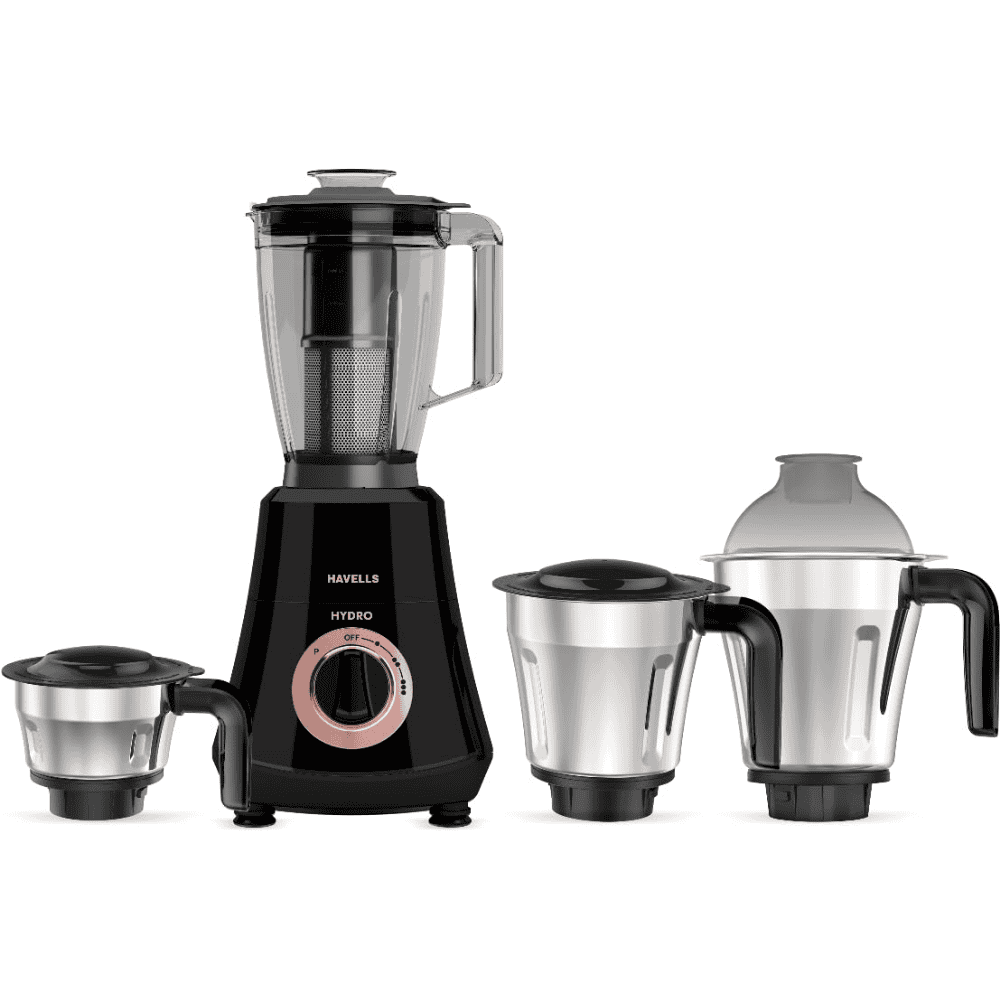
5) Havells Hydro Plus / Hexo (1000W)
- Performance
- Strong 1000W motor with high RPM and long-run capability.
- Ideal for frequent wet grinding and large batches.
- Jar Configuration
- Typically includes multiple high-capacity jars for wet, dry, and chutney grinding.
- Jars reinforced for heavy use.
- Pros
- Designed for long continuous grinding.
- Durable jar build and strong motor cooling.
- Higher sustained performance.
- Cons
- Higher noise and power consumption.
- Larger and heavier design.
- Best For
- Big families, heavy users, and home cooks who grind often.
- Extra Tips
- Follow recommended duty cycles to preserve motor life.
- Choose models with motor protection features.
What Is a 750W Mixer Grinder?
A 750W mixer grinder has a medium-power motor designed mainly for regular household cooking.
It is the most commonly used wattage in Indian homes because it offers a balance between power, efficiency, price, and durability.
Typical Tasks a 750W Mixer Can Handle Easily
- Chutneys (coconut, tomato, onion)
- Dry masala grinding
- Smoothies and shakes
- Grinding soaked dals (in moderate quantity)
- Wet grinding for small batches
Limitations of a 750W Mixer
- Not ideal for continuous heavy grinding
- Motor may heat up if used non-stop for long durations
- Struggles with very large quantities at once
If you are looking for the right model, you can also read our detailed guide on the best 750W mixer grinder for Indian homes.
What Is a 1000W Mixer Grinder?
A 1000W mixer grinder comes with a high-power motor meant for heavy-duty usage.
These mixers are usually preferred by:
- Large families
- People who cook in bulk
- Small hotels or catering kitchens
- Users who frequently grind hard ingredients
Typical Tasks a 1000W Mixer Can Handle
- Large quantities of idli/dosa batter
- Continuous coconut grinding
- Hard spices like turmeric and dry masala
- Commercial-style cooking workloads
Limitations of a 1000W Mixer
- Higher electricity consumption
- Louder noise
- Higher price
- Bigger size and heavier body
For heavy-duty users, our comparison of the best 1000W mixer grinders may help you choose the right option.
Which Mixer Is Best 750W or 1000W? — Usage-Based Comparison
Instead of asking which one is better overall, the right question is:
Which mixer is best 750W or 1000W for your specific usage?
Let’s break this down clearly.
Daily Cooking Needs in Indian Homes
Most Indian households use a mixer grinder for:
- Morning chutney
- Occasional dosa batter
- Dry masalas
- Smoothies
- Grinding soaked ingredients in small quantities
For this type of usage:
- A 750W mixer grinder is more than sufficient
- A 1000W mixer becomes unnecessary overkill
Family Size and Mixer Wattage
Small Families (1–3 members)
- Light daily use
- Smaller grinding quantities
✅ 750W is ideal
Medium Families (4–5 members)
- Regular daily cooking
- Occasional heavy grinding
✅ 750W is still enough
Large Families (6+ members)
- Bulk cooking
- Frequent wet grinding
✅ 1000W may be useful
Wet Grinding Performance: 750W vs 1000W
Wet grinding is one of the most demanding tasks for a mixer.
750W Mixer
- Can grind idli/dosa batter in small to medium batches
- Needs short breaks to avoid overheating
- Slower compared to 1000W
1000W Mixer
- Handles wet grinding easily
- Suitable for large quantities
- Can run longer without stress
👉 If wet grinding is occasional, choose 750W
👉 If wet grinding is daily and heavy, choose 1000W
Dry Grinding & Masala Grinding Comparison
Dry grinding includes:
- Pepper
- Cumin
- Coriander
- Dry chilies
- Garam masala
750W Performance
- Excellent for home quantities
- Fine texture with proper jars
- Lower noise
1000W Performance
- Faster grinding
- Suitable for bulk grinding
- Higher noise level
👉 For normal household masalas, 750W is enough.
Electricity Consumption: Which Is More Efficient?
Power consumption matters in long-term usage.
- 750W mixer uses less electricity
- 1000W mixer consumes more power per operation
For daily use:
- 750W helps reduce electricity bills
- 1000W increases running cost
This is one of the biggest reasons why many people regret buying higher wattage unnecessarily.
Noise Level Comparison
Noise is often ignored during purchase but becomes annoying later.
750W Mixer
- Moderate noise
- Acceptable for apartments
- Less vibration
1000W Mixer
- Loud noise
- Strong vibration
- Not ideal for early morning use in flats
Heat Generation & Motor Life
Motor heat directly affects durability.
- 750W motors generate less heat
- 1000W motors generate more heat, especially during continuous use
For long-term durability:
- Proper usage matters more than wattage
- Overpowered mixers often suffer from misuse
Maintenance and Repair Cost
750W Mixer
- Lower service cost
- Easily available spare parts
- Less wear and tear
1000W Mixer
- Higher maintenance cost
- Parts are more expensive
- Repairs cost more
Price Difference: 750W vs 1000W
Typical price range in India:
- 750W mixer grinder: Mid-range pricing, affordable for most homes
- 1000W mixer grinder: Premium pricing
If your usage does not justify the extra power, spending more does not give better value.
Kitchen Space and Mixer Size
1000W mixers are:
- Bulkier
- Heavier
- Require more counter space
750W mixers are:
- Compact
- Easy to move
- Better for small kitchens
Safety Considerations
Higher wattage mixers:
- Need stronger electrical wiring
- Must not be used with extension cords
- Require proper earthing
750W mixers:
- Safer for standard household sockets
- Lower risk of overload
Common Myths About Mixer Wattage
Myth 1: Higher wattage means better quality
❌ False. Quality depends on motor design and build, not wattage alone.
Myth 2: 1000W mixers last longer
❌ Not necessarily. Improper usage shortens life.
Myth 3: 750W is outdated
❌ 750W is still the most practical choice for Indian homes.
Which Mixer Is Best 750W or 1000W? — Scenario-Based Answer
Choose 750W Mixer if:
- You cook daily at home
- Family size is small to medium
- Wet grinding is occasional
- You want energy efficiency
- Budget matters
Choose 1000W Mixer if:
- You grind large quantities daily
- You prepare batter frequently
- You have a large family
- You want faster grinding
- Noise and electricity cost are not concerns
Long-Term Practical Recommendation
From real-world Indian kitchen usage, it is clear that:
👉 For 80–90% of Indian households, a 750W mixer grinder is the best choice.
A 1000W mixer makes sense only when the usage genuinely demands it.
750W vs 1000W Mixer Grinder – Comparison Table
| Feature | 750W Mixer Grinder | 1000W Mixer Grinder |
|---|---|---|
| Motor Power | Suitable for daily home use | High power for heavy-duty use |
| Family Size | Ideal for 2–5 members | Best for 6+ members |
| Wet Grinding | Small to medium quantities | Large quantities easily |
| Electricity Usage | Lower power consumption | Higher power consumption |
| Noise Level | Moderate, apartment-friendly | Loud and heavy |
| Maintenance Cost | Low and affordable | Higher maintenance cost |
| Best For | Most Indian households | Heavy users & bulk cooking |
Still confused? Check the latest prices of top mixer grinders on Amazon
Frequently Asked Questions (FAQs)
1. Which mixer is best 750W or 1000W for home use?
For most Indian homes, a 750W mixer grinder is the best choice. It is powerful enough for daily cooking tasks like chutneys, masalas, and occasional wet grinding, while consuming less electricity.
2. Is 1000W mixer grinder necessary for Indian cooking?
No, a 1000W mixer grinder is not necessary for regular home cooking. It is mainly useful for large families or users who grind heavy quantities frequently.
3. Can a 750W mixer grind idli or dosa batter?
Yes, a 750W mixer grinder can grind idli and dosa batter in small to medium quantities. For very large batches, grinding in intervals is recommended.
4. Which mixer consumes more electricity, 750W or 1000W?
A 1000W mixer grinder consumes more electricity compared to a 750W model. For daily use, a 750W mixer is more energy-efficient and economical.
5. Does higher wattage mean better mixer performance?
Not always. Higher wattage means more power, but performance also depends on motor quality, blade design, jar quality, and proper usage.
6. Is a 1000W mixer too noisy for home use?
Yes, compared to 750W mixers, 1000W mixers are generally louder and may not be ideal for apartments or early-morning cooking.
7. Which mixer is better for long-term use, 750W or 1000W?
For long-term home use, a 750W mixer grinder often lasts longer because it operates with less heat and stress when used for regular household tasks.
If you are still wondering which mixer is best 750W or 1000W, the answer depends mainly on how you use it in your kitchen. For most Indian homes, a 750W mixer grinder offers the right balance of power, efficiency, and affordability for daily cooking needs. It handles routine tasks like chutneys, masalas, and occasional wet grinding without consuming excess electricity or creating too much noise. A 1000W mixer grinder, on the other hand, is suitable only for large families or users who grind heavy quantities frequently. Choosing a higher wattage without real need often leads to higher costs and energy consumption. Instead of focusing only on power, understanding your cooking habits will help you make a smarter choice. When selected correctly, the right mixer wattage can make everyday cooking easier, safer, and more economical.